Providence eLearning has several of the books you normally can get for the iPad on iBooks available through udemy.com. For $10 you can access the videos as well as the audio narration and footnotes, if they were available in the book, (iBook cost is $9.99) as often as you like with lifetime access. So, if you don't want to make the hardware investment, you can enjoy the video lectures on your PC or laptop.
Enjoy!!!
Showing posts with label homeschooling. Show all posts
Showing posts with label homeschooling. Show all posts
Friday, November 1, 2013


The Transmogrifier has been used at my house
"Words fail me."
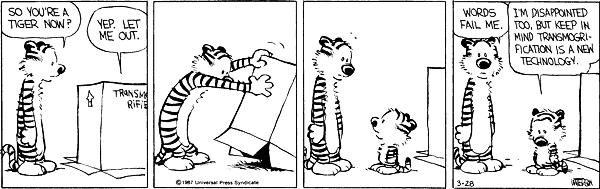
© Universal Press Syndicate
The transmogrifier has been used at my house. Somehow, my eight year old blond precocious boy has transformed and is carrying a stuffed tiger, wearing a red and blue striped shirt and spiking his hair. Really. I'm not kidding. And you can imagine the things he is doing. Hobbes even came to church with us and I had to hold his paw during the "Our Father."
He's taken to playing Calvin ball.
That's the problem with a homeschool education. I think they sometimes go a little far. He is convinced he's Calvin and is refusing to respond to his own name. What's worse is he has decided that school is a waste of time because it's just a cruel way of making him remember stuff that doesn't matter to him. He wants to go off and hunt more tigers in the woods and build robots out of cardboard boxes.
What's a mom to do? Let him be Calvin for a little while. I can't complain. He has read and reread every single comic in the COMPLETE CALVIN AND HOBBES 4 Volume set over and over again, repeatedly. I will let him be Calvin for a while and then I can use the Transmogrifier to become Miss Wormwood a little later. Where DID I put that green dress with purple polka-dots?
Thursday, May 30, 2013
Games For Learning


Here is our local store. We found almost every supply we needed from poster board to stickers, page protectors to markers! They also had flash cards, workbooks to use for designs and coloring books.


So if you come to my workshop expect to here the praises of the Dollar Store and I will show some more pictures. I promise!
Tuesday, April 30, 2013
Are you going?

Folks, the Minnesota Catholic Home Educator's Conference is coming right up. We are just a month away! And, if you blog, consider checking this out. It's posted by the sweetest blogger in the state. And, I will be there, too. I hope that doesn't keep you from attending :-).
For what it is worth, I will be hosting the next session on homeschooling children with special needs right after the Blogger's Chat.
On Saturday, I will be speaking about Beginning Homeschooling at 11am and making learning fun by using some very easy game ideas at 3pm. You can get more details here, if you like. I hope you can make it.
Wednesday, April 10, 2013
Know Thyself
Plato wrote that Socrates says people make themselves appear ridiculous when they are trying to know obscure things before they know themselves. I feel very strongly that teens that "Know Themselves" have a better chance of success in life. We do a lot of "know thyself" tests around here.
One of the most important tests I had the kids do was: Strengths Quest - Strengths Based Test for Teens. As many of my readers know, I love the Strengths Based Tests. So do my kids. It was fun to see similarities and differences between my two teens, my husband and me. I think discovering this information has helped us all to be a little more tolerant and understanding, too.
For example, my teen son's highest strength is: Positivity. Now, anyone that knows my son would see that. But combine that with Individualization, Woo, Communication and Activator, you have someone that can get people to get things done. He's a ring leader in the most positive sense. He has a future in Sales or Recruiting or Teaching. And since he can read people well, he is very good at finding the right gift or book for someone. He's my go-to guy for buying presents in the family.
My daughter, on the other hand, scored highest in Input, like her trivia-loving dad. She has to research, collect and research some more. No surprise here, but learning that she also has Maximizer, Intellection, Harmony and Responsibility, means she has a combination that means she's reliable, thorough and fair. If we want to know the "right" thing to do in a situation, we ask her. Unfortunately, those traits can set her up to not want to decide on things because she never has enough information (input), wants to give the RIGHT answer (Harmony and Responsibility) and the BEST answer (Maximizer and Intellection). She's truly the fairest in the land, or at least at our house (and I mean that both ways).
I also spent the money to have them do the Strong Interest Inventory. High school is a time to consider your strengths and interests to know what vocation you might pursue. The results here, too, were extremely interesting because they took into consideration my children's interests in combination with their strengths.
As we do high school, I want my kids to know themselves better than I knew myself at that age. I had an abysmal high school counselor who just wanted girls to go to college. However, no one ever took into consideration any of my strengths when counseling me. I had good grades in Math, Science and English. So, I was directed to go the Math/Science route. Surprise, surprise, my highest scores on my SATs were English (or whatever they called it wayyyy back then.) So, I enrolled in a predominantly male high technology program because I was assured that I would be guaranteed a job because I was a woman (no one ever spoke of my abilities). And, then, I made sure that I did my best, got scholarships and good grades. I don't regret what I did. However, the program really didn't fit my strengths.
Have you ever heard the adage "Do what you love and the money will follow?" Once I changed direction in my career to better match my strengths, I did very well and looked forward to going to work EVERY.SINGLE.DAY. That was not the case on my first chosen career path (Laser Engineering) but it was the case before I left the work world to stay at home with my children (Curriculum Development, Subject Matter Expert, Training Development and Delivery).
So, given my kids don't have a high school counselor, not that mine really helped me, I wanted to give them things to think about and information about vocations that matched their strengths and interests. I do not receive any kick back for this, but you can purchase the Strong Interest Inventory (now called iStartStrong) at www.homeschoolbuyersco-op.org for half price. It's a good place to start and if you have a child that is unsure of their future interests, this might be a place to start.
The Homeschool Buyer Co-op is a free homeschooling organization for both new and veteran homeschoolers. Co-op membership is free and confidential, and entitles homeschooling families to GroupBuy discounts on high-quality curriculum. On the site you'll find lots of free information, such as databases of free curriculum, field trips, and educational contests and scholarships. Highly recommended. Click here for more information.
One of the most important tests I had the kids do was: Strengths Quest - Strengths Based Test for Teens. As many of my readers know, I love the Strengths Based Tests. So do my kids. It was fun to see similarities and differences between my two teens, my husband and me. I think discovering this information has helped us all to be a little more tolerant and understanding, too.
For example, my teen son's highest strength is: Positivity. Now, anyone that knows my son would see that. But combine that with Individualization, Woo, Communication and Activator, you have someone that can get people to get things done. He's a ring leader in the most positive sense. He has a future in Sales or Recruiting or Teaching. And since he can read people well, he is very good at finding the right gift or book for someone. He's my go-to guy for buying presents in the family.
My daughter, on the other hand, scored highest in Input, like her trivia-loving dad. She has to research, collect and research some more. No surprise here, but learning that she also has Maximizer, Intellection, Harmony and Responsibility, means she has a combination that means she's reliable, thorough and fair. If we want to know the "right" thing to do in a situation, we ask her. Unfortunately, those traits can set her up to not want to decide on things because she never has enough information (input), wants to give the RIGHT answer (Harmony and Responsibility) and the BEST answer (Maximizer and Intellection). She's truly the fairest in the land, or at least at our house (and I mean that both ways).
I also spent the money to have them do the Strong Interest Inventory. High school is a time to consider your strengths and interests to know what vocation you might pursue. The results here, too, were extremely interesting because they took into consideration my children's interests in combination with their strengths.
As we do high school, I want my kids to know themselves better than I knew myself at that age. I had an abysmal high school counselor who just wanted girls to go to college. However, no one ever took into consideration any of my strengths when counseling me. I had good grades in Math, Science and English. So, I was directed to go the Math/Science route. Surprise, surprise, my highest scores on my SATs were English (or whatever they called it wayyyy back then.) So, I enrolled in a predominantly male high technology program because I was assured that I would be guaranteed a job because I was a woman (no one ever spoke of my abilities). And, then, I made sure that I did my best, got scholarships and good grades. I don't regret what I did. However, the program really didn't fit my strengths.
Have you ever heard the adage "Do what you love and the money will follow?" Once I changed direction in my career to better match my strengths, I did very well and looked forward to going to work EVERY.SINGLE.DAY. That was not the case on my first chosen career path (Laser Engineering) but it was the case before I left the work world to stay at home with my children (Curriculum Development, Subject Matter Expert, Training Development and Delivery).
So, given my kids don't have a high school counselor, not that mine really helped me, I wanted to give them things to think about and information about vocations that matched their strengths and interests. I do not receive any kick back for this, but you can purchase the Strong Interest Inventory (now called iStartStrong) at www.homeschoolbuyersco-op.org for half price. It's a good place to start and if you have a child that is unsure of their future interests, this might be a place to start.
The Homeschool Buyer Co-op is a free homeschooling organization for both new and veteran homeschoolers. Co-op membership is free and confidential, and entitles homeschooling families to GroupBuy discounts on high-quality curriculum. On the site you'll find lots of free information, such as databases of free curriculum, field trips, and educational contests and scholarships. Highly recommended. Click here for more information.
Monday, January 7, 2013
Solving Problems Vs. Creating Solutions - A Mindset Context Switch
With all that has been going on in my schoolroom this year, I have had to change my mindset. In fact, I've decided to take on the slogan of the Robinson family from "Meet the Robinsons."
The comments in parenthesis above are mine. According to Robert Fritz, when talking about problem solving in a particular scenario in the corporate world, "The problem led to action to solve the problem. The action lessened the problem. Less action was needed to solve the problem. Less attention was given to the problem, and the problem resurfaced. Problem solving," Fritz explains, "provides a way to organize our focus, actions, time, and thought process. Designing solutions to problems gives the sense that something important is being done."
| Slogan of the Robinson Family - Keep Moving Foward! |
Let me ask you this...Are you a problem solver or someone who finds creative solutions?
I have always considered myself a "problem solver." While that might be a great title to have, I think it might be determental to my kids if their teacher is constantly trying to solve problems in her school. I now try to actively seek creative solutions rather than focus on solving problems. Why? Creating solutions and problem solving involve very different states of mind. Creativity activates positive thoughts while problem solving is focused on what is negative. Creating is forward focused; it’s building toward the future. Problem solving is focused on the past.
I've had to make a context switch.
When I tell my kids "we have a problem" it casts a dark tone over the day and the person to whom this message is directed. What if, instead we said something like, "Wow! We need to find a new way to do this!" I don't know about you, but my kids much prefer the later.
I have always considered myself a "problem solver." While that might be a great title to have, I think it might be determental to my kids if their teacher is constantly trying to solve problems in her school. I now try to actively seek creative solutions rather than focus on solving problems. Why? Creating solutions and problem solving involve very different states of mind. Creativity activates positive thoughts while problem solving is focused on what is negative. Creating is forward focused; it’s building toward the future. Problem solving is focused on the past.
I've had to make a context switch.
When I tell my kids "we have a problem" it casts a dark tone over the day and the person to whom this message is directed. What if, instead we said something like, "Wow! We need to find a new way to do this!" I don't know about you, but my kids much prefer the later.
What does creating look like?
There are five steps in the creative process from Robert Fritz, which are types of action, not a formula. These steps are:
- Conceive of the result you want to create. Creators start at the end by knowing what they want to create. (By the way, this is the way Right Brainers think all the time. We start with the end in mind.)
- Know what condition or situation currently exists. If you don’t know what has already been created or done, it’s impossible to know what to do next. (This is where most people stop!)
- Take action. When you know what you want and what you currently have, take action. Creating is a learning process, so every action may not work. When actions don’t work, readjust. (Take a lesson from the Military - do an After Action Review. Figure out what worked and what didn't so you don't have to redo it again. Keep moving forward!)
- Learn the rhythms of the creative process. There are three phases: germination, assimilation, and completion. (Listen to the niggling voice in your head...ideas come in the strangest places and at the strangest times. Most of mine come after 11pm when talking with my husband.)
- Create momentum. Professional creators create momentum. The seeds of their next action are planted and germinate in their present actions. (Keep improving and keep talking about your changes with someone. Sounding boards have a good way of keeping you in check and moving forward.)
The comments in parenthesis above are mine. According to Robert Fritz, when talking about problem solving in a particular scenario in the corporate world, "The problem led to action to solve the problem. The action lessened the problem. Less action was needed to solve the problem. Less attention was given to the problem, and the problem resurfaced. Problem solving," Fritz explains, "provides a way to organize our focus, actions, time, and thought process. Designing solutions to problems gives the sense that something important is being done."
He adds, “…it’s an illusion.”
What’s the alternative if designing solutions to problems doesn’t work? It is in finding creative solutions. Now, you might say, "That is in the corporate world! I am a home educator. When my kid has a problem, I need to find a solution!" I can tell you that after years of trying to fix my son's dysgraphia, I realized that I needed to find creative solutions to the problem rather than to fix him. He wasn't broken. He just wasn't able to do what I was asking him. Poor kid. I am astounded at his resiliancy given I kept trying to fix him.
So, the first thing you need to do is change your language. Notice that the word “problem” is not present in the five steps above. The tone is positive and growth oriented.
What do you think could happen if instead of telling your child "There is a problem" to changing your approach to "Let's find a better way?"
Thursday, December 20, 2012
A fork in the road...
The last month and a half have been fraught with worry and much self reflection. I've kept my posts to reviews of late because I needed to reassess where I wanted to go with this blog. For the most part, this blog is about me and my journey of self-education and the homeschool education I am helping my children attain. But I've reached a fork in the road.
I learned early on in my career as homeschool teacher is that I can't teach my kids anything they don't want to learn. My talk on motivation covers that in spades and I've got the research to back it up...they will learn something they don't want to learn to earn a grade or pass a test, but will most likely forget it if it is not of interest or not made of interest to them. We, as a race, are pretty selfish in that respect, but it is all part of God's plan, I think. He gives us all different interests for a reason. We all can't be interested in the same thing or we wouldn't survive. We can't all be doctors or engineers.
One thing I was not prepared for, in this homeschooling journey, was hurdles. BC (Before children) I taught adults and developed curriculum. I figured I had this "teaching thing" down pat. Kids must be easier. I faced difficulties that I assumed were much greater teaching adults, like being a very young diminutive female teaching men in a positions that were predominantly occupied by older male know-it-alls. I taught UNIX system and network administrators at the upper level of their professions. Remember the SNL skits done by Jimmy Fallon as the system guy, Nick Burns?
That's the type I'm talking about. To be fair, not all my students were like that, but many were.
Who knew that teaching kids would be/could be harder than THAT? Certainly not me!
But, that's good. I love a challenge. I just wasn't prepared for so many.
So, you may ask what those challenges were? For many homeschoolers, they were just normal things like morning sickness that lasted all day and pregnancy fatigue that made me not want to do school - at all! Or, a parent who was terminally ill and had no one but me in town to care for them. Or unemployment which made schooling the way I wanted to not easy, requiring creative curriculum methods, and illness and health issues on my part that knocked me on my backside. But those were my challenges...more difficult were things that affected my kids learning like learning disabilities, mindset issues and boredom.
Why am I writing ALL this? Because I've reached a fork in the road and the tone of this blog will be changing. Up until now, I've purposely not explained my interest in special needs, though I've gotten lots of experience with it over the last ten years. My son, who is 14 1/2, has had vision problems since he was one. He's had surgeries, glasses, vision therapy, occupational therapy, and neurological therapy to work through issues he's had that have affected his vision and fine motor skills. I've done a lot of accommodating, correcting, adjusting curriculum and environment to make learning easier for him. It's paid off. He's a smart kid who loves to learn and is a hard worker, but I can't take too much credit for that because he's the one who has chosen to learn. I had chalked up his need for lots of different learning accommodations to his vision issues. When your eyes don't work, other senses try to make up for that difficulty. My son is an auditory/tactile-kinesthetic right-brained learner for whom adjustments have been made to meet his distinctly different and individual needs.
I knew that as college testing loomed ahead of us he would need some accommodations for testing. I knew, even after all the work we've done, he might need more time to finish his tests and the written essay portion would be next to impossible for him. A good friend of mine who is an Orton-Gillingham professional, recommended that I have him tested for learning disabilities before he started taking ACTs or SATs. They will not give accommodations without a clinical diagnosis.
So last month he endured twelve long hours of neuro-cognitive testing as well as filling out several questionnaires outside that in-office testing time. I spent time filling out forms, finding copies of previous years' standardize test results, and pouring through all his medical records and therapy records to provide the psychologist with a complete picture of his academic and neuro-cognitive development. Then we waited three long weeks for all the tests to be scored and a diagnosis to be made, if necessary. And in that time, I worried and questioned my methods and made myself and my husband crazy, wondering - did I do enough, could I have done more, what would the psychologist say, how would my son score? During that time of self-reflection, I also worried how my son would handle any news he received.
Two weeks ago my husband and I met with the psychologist to receive the results. We purposely chose to take some time to reflect on how to share the news with our son and to decide how best to adjust things as we continue with the challenge of high school before sharing that news with him.
So, if you have read this far, God bless you for your patience.
Here's what we found. While my son is gifted in some areas, he was diagnosed with AD/HD, a diagnosis I, up until now have despised. I'll get to that in a minute. The other diagnosis was dysgraphia. That was no surprise. When he works at it, his penmanship is legible, but large. With lots of work and concentration, he can do copywork well. However, he just can't write extemporaneously. But, he can type.
The funny thing was that my husband, who has had to deal with my anxiety over all this, realized that as he listened to the psychologist's recommendations, that I was doing almost all those things he recommended. On the way out, he said that if we didn't need that "clinical diagnosis" for our son's benefit during ACTs and SATs, he would have wondered why we were there. I needed to hear that.
Yesterday, I had the conversation with my son. We talked about what will change in his schooling to make things better for him and allow him to better reach his potential. We will also be making different accommodations and I will learn to embrace AD/HD. I asked his permission to write about it here. He said that if it helped other people, he was okay with it. He's my hero. This kid will do great things. I know it.
So, I will be changing the tone of this blog. You will find plenty of blogs about homeschooling normal kids. I will be embracing my smart 2e kids (Twice Exceptional is the clinical term, 2e the short hand). And, I will be writing more about adjusting things in the homeschool to better accommodate those kids who don't learn the same way other kids do, but are just as smart, and just as important as the rest.
Monday, December 3, 2012
Classically Catholic Memory - Memory work worth doing
A friend recently emailed me asking what I thought of doing CCM (Classically Catholic Memory) in terms of Anthony Esolen's most excellent book Ten Ways to Destroy the Imagination of Your Child that I reviewed a few years ago. I love Esolen's work for many reasons, but mostly because he was able to articulate many things I thought and felt, but could not properly put down on paper. That's why I read books like his. I knew I would agree. His book gave me the words and arguments to support my opinions.
Now, one must remember that Esolen's book is ironic, like Screwtape writing letters to his nephew, Wormwood, in the Screwtape letters. So, it requires you to look at his advice as contrary to your desired goal. In the first chapter, he talks about Mr. Gradgrind in Hard Times. Mr. Gradgrind asks Cissy (who is a horse breaker's daughter) what a horse is. She is unable to answer him. Mr. Gradgrind declares she knows no facts about horses. Esolen warns about the danger of facts :-). In fact on page 8 he asks,"of what use to us now are Facts? Surely in the case of homeschooled boys, we have seen Facts run amok." He spends the entire chapter bemoaning anyone learning facts, because once you learn a fact you might actually learn more about the subject! Oh no! So the danger he is really pointing out is memorizing the facts only.
If you have a right brain kid, memorizing is hard work. The way you get it to work is to explain the big picture and drill down to the fact they are memorizing, which not only helps them (whole->parts learning) but also give them the context about why they are memorizing this information.
CCM is not focused on just memorizing the facts. It's learning the why's and what's about the facts. So, our CCM classes are not simply rote memorization. They are not just about reciting the facts. Our class time each week is spent explaining why we are memorizing these things and in what context the facts exist. We are not just chanting and reciting...
This week, in fact, WEEK 7, if you are wondering, we were able to make many connections about things the kids have learn within the context of Religion, Timeline, Geography and History. The Science class, the most interesting so far, keeps building on fact they have already learned, broadening their horizons in areas I've never approached with my kids on my own. How many homeschoolers do you know have dissected an earthworm and lived to tell about it? We have. And, really looking at the earthworm hearts wasn't nearly as interesting as the looks on all the kids' faces. The kids really will remember that forever.
So, is CCM just about facts? No. It could be, but with the right teachers and kids with the right attitude, it is not.
"A fact may not be much, by itself, but it points toward what is true, and even the humblest truth may in time lead a mind to contemplate the beautiful and the good..."
Monday, September 24, 2012
Review of Beowulf: An iBook from Providence eLearning

I'm sorry in the delay in getting these reviews out to you. Reviewing these textbooks has been guilty pleasure for me and I've been delinquent in sharing them with you.
This was the third book I reviewed for Providence eLearning as a consulting project, and the second I will review here.
I haven't read Beowulf in over thirty years. And, when I read it as a ninth grader, I really didn't care for it because I thought it was for boys. Ha!
Two years ago, I was reintroduced to Beowulf when we read Mary Pope Osborne's Favorite Medieval Tales for my boy's book club. Whatever was lost on me in the ninth grade was found! I enjoyed her exposition of the story and promised myself to go back to it. This summer, I participated in an adult book club on-line and our first read was none other than Beowulf. That was about two weeks before I got to review Providence eLearning's version of Beowulf.
Providence eLearning's translation was very close to the Tolkien translation that I read for the book club. I was very surprised by how much more I got out of the book after listening to the video lectures that followed every few pages of text. Not only were the videos useful, but the audio narration with the names pronounced correctly was more helpful than almost anything. I really don't do very well guessing pronunciations in other languages. Just not my skill. Mr. William Lasseter, the English Chair at Providence Academy, is the instructor and narrator. His voice and teaching skills are truly showcased by this book.
The video "enhanced" textbook is a boon to homeschoolers. Any student that doesn't have a discussion group or is working through this text on their own will find great value in this iBook. The lectures and video production are well done. Old book illustrations were used along with other great artist renditions of the tale. The video production is a beautiful synthesis of new technology with a medieval tale and fine art. Having the ability to look up words on the fly, check the glossary, check your understanding and have the text narrated to you all enhance your experience. While the video piece is wonderful, I would be doing you a disservice not to mention all the other perks of using an iBook. This textbook would be helpful to high-schoolers assigned the task of reading Beowulf.
This epic tale is wonderfully told and explained in this rendition of Beowulf. I highly recommend this engaging iBook. Bonus - it's on sale right now at the iTunes Store for $6.99.
Monday, July 30, 2012
iPad vs. Kindle Fire
This post is for Sherrylynne and Margaret.
UPDATE: I've been told that this is too long to read by members of my family. They're beautifully honest and I'm not bothered by the feedback. Here's a tip. If you don't want to slog through my narrative, scroll down to the bottom for a handy little table where I scored the iPad and the Kindle Fire on features I felt were important.
I have a problem with technology. The problem is that I love it and so does my husband, which tends to make us fairly "early adopters." That means we tend to be ahead of the curve when new technology comes out to the public.
I have had several people ask me to explain the differences between an iPad and a Kindle Fire with respect to homeschool use. So here goes.
Oh, and for the record, before children, I was, ahem, a UNIX snob. I disdained PC's and Macs even more! For a long time, I had a New Hampshire state automobile license plate. The state motto "Live Free or Die" was on the top and the license plate said "UNIX." That was how seriously I loved UNIX. All other operating systems were chopped liver to me. I loved it so much, I created a Post Secondary Degree program around a version of UNIX I loved. A Technical School actually paid me to develop the curriculum and teach that Degree Program for three years. Then I quit because I was pregnant with my third child. I taught up until two days before she was born. But I digress...
So, we had a Kindle here fairly early on mainly because my husband got his hands on an ebook back in 2004, before they actually were available on the market when he managed a product testing lab for a major consumer electronics retailer. We all fell in love with it, but there were so few books available at that time, it was not viable as a product when there was no materials to read on the device. So we loved the Kindle. My three eldest children have used the Kindle before we purchased the iPad. I have reservations about even the regular Kindle. Here are the reservations: There are no parental controls. None. They have a "experimental browser" that is horrible to navigate, but there are no controls to prevent accessing unsavory web sites. Also, many "free books" at Amazon available are not suitable for children.
When the first iPad came out, we were not quick to jump. It was, after all, an Apple product (horror of horrors!) All it took was a visit to the Apple store at the Mall of America to quickly change my mind. While Angry Birds did have appeal (I swear that must be how they get most people hooked), what really did it for me was the number of free and low cost apps available. Apple totally understands how to make a product appealing, doesn't it? We didn't have the funds to get one as soon as we would like as our technology budget has dwindled to practically nothing since braces hit our house. Three kids have some type of orthodontia!
It wasn't until about six months after their release that I got a refurbished first generation iPad. Being that I needed to do "research" I got to use it the most the first week we had it. I learned how to use iTunes and played with setting up parental controls. Then, I went in search of apps. Did you know there are over 500,000 apps in the Apple Apps Store? So, cheapo that I am, I downloaded free apps first, just to see what was out there. Even the free apps are great. Many free apps are there to tease you, get you excited so you'll purchase their full version. The iPad because so useful in our homeschool, that seven months later, we invested in another refurbished first generation iPad. A month later, I got a Kindle Fire for Christmas. When I did some work this Spring, I opted to use the money I made to purchase an iPad 2 with 3G. So, I set out to try to use the Kindle Fire the same way we had been using the iPad, which I will outline next.
Each day, my kids are required to do some school activities on their own, even my younger kids. It's not like I'm some great mom. In fact it is the opposite. There often isn't enough of me to go around quizzing flashcards and the like, so we've used the iPad for much of that type of activity. We started out using the iPad just for educational games. Then we branched out to using it for actual school. Here are some of the things we did with the iPad:
So, element by element, I will take you through the features that are important for me as a Catholic homeschool mom of six.
First and foremost is parental controls. I love Apple's approach to restrictions. It's actually pretty granular. I can first put on a screen lock to prevent access to the device. Period. Next, I can set up restrictions by app type. For example, I can turn off the web browser Safari, which I do, and then decided to allow access to Youtube, Camera and Facetime for second generation and newer, iTunes, Ping, Installing and Deleting Apps. Further, I disable location services, change the level of allowed content for Music and Podcasts, Movies, TV Shows, and Apps. I can also disable In-App Purchases, which I recommend, disable Multiplayer Games and Adding Friends. My older children have iPod touches because we've now exceeded the demand for the iPads. Their age restrictions are different on their iPod touches than on the iPads. The Kindle Fire handles parental controls differently. First of all, they didn't add them until people screamed to them about it. They were finally added in May. Like Apple, there is a screen lock to prevent access to the device. However, their interface is not as seamless as Apples. Like Apple, the Settings feature has many choices. All apps, books, video, etc, is accessible from the "Carousel" on the home page. When you go into the Parental Controls, you may disable web access, therefore turning off browsing, apps and book purchases and downloads. However, there is no way to limit access to certain apps. Now, here's a disclaimer. I have a personal bias against how Amazon decided to do their interface. I have an extreme dislike for the Carousel. Everything is accessed from the Carousel. Above the Carousel is a selection of functions like: Newstand, Books, Music, Video, Docs, Apps, Web. If parental controls are set, the user will get a pop-up saying the feature is disabled. I find the Settings Interface more cludge-y than the iPad, so I don't care to mess around much with the Apps. One thing I will point out. I will allow use of Safari for a school project if my kids ask, but I won't for the Kindle Fire because I have figured out how to set up OpenDNS on the iPad, but not on the Kindle Fire. I also find the pinch and squeeze is less receptive on the Kindle than the iPad, so inputting data is not nearly as easy. One last thing, I promise. There is a Kindle Fire app called Kid's Place that allows me to set a timer and select which apps are used.
I've already mentioned cost. On the whole, I'm not afraid to purchase refurbished items. It's like buying a used car versus a new one. I compared the costs below, but used only new prices because refurbished prices vary wildly.
I've already mentioned Apps. There are many Android apps, but there are not many great Education Apps. The Android platform is really intended for smartphones. Tablets started using the Android platform as an afterthought. I have not found much I would use for my older kids other than things like SAT prep apps.
Both devices have the Kindle Reader, which is my favorite interface for books.
The Kindle Reader, however, does not readily support ePub. That is an issue for me with because I often check out books from the public library. Their supported format is ePub via the OverDrive application. Apparently it can be done, but I just haven't gone there yet.
Both devices are great for video and audio playback. However, the Kindle Fire lost a point because it doesn't have a physical volume button like the iPad.
I love having a camera on the iPad 2. Married with the 3G capability, I can go places like Oliver Kelly Farm, a historic farm and take pictures or video and mail it right away or Skype with someone to show them something cool. I can also do online classes. I teach several classes to kids other than my own and we use Skype. I can do it from anywhere now.
I love the Kindle Fire's form factor. The iPad is roughly the size of a sheet of paper. The Kindle Fire is roughly that of a large greeting card (or about a half a sheet of paper.) However, the Kindle is thicker than the iPad. The Kindle Fire weighs almost 15 ounces and the iPad weighs in at about 21 ounces.
From a stability perspective, the iPad has never crashed and it's used often. The Kindle Fire, on the other hand, has had several occasions where it has frozen up so badly I've had to contact customer service.
My iPads have held their battery charge through about 8 hours of use. We do a lot to try and conserve that battery life like turning off Wi-Fi by putting it in Airplane Mode, dimming the screen and disabling a lot of the sounds/alerts. The Kindle Fire, on the other hand, has an advertised battery life of 8 hours, but we are lucky to get six. We disable the Wi-Fi there as well, but that hasn't bought us much for battery life.
The iPad storage capacity starts at 16GB and goes up to 64GB. The Kindle Fire only has 8GB. Now, that being said, you won't use that space up until you have had lots and lots of books and memory stored on it. It can go quickly on the iPad if the iPad has a camera.
Here's a little table I put together scoring the features. I multiplied each * by the weight. So, if the weight is 10, three stars means the device scored 30 points. I added them up for you at the bottom.
Please feel free to comment and give my your experiences because I am basing mine totally on the use in our homeschool.
UPDATE: I've been told that this is too long to read by members of my family. They're beautifully honest and I'm not bothered by the feedback. Here's a tip. If you don't want to slog through my narrative, scroll down to the bottom for a handy little table where I scored the iPad and the Kindle Fire on features I felt were important.
I have a problem with technology. The problem is that I love it and so does my husband, which tends to make us fairly "early adopters." That means we tend to be ahead of the curve when new technology comes out to the public.
I have had several people ask me to explain the differences between an iPad and a Kindle Fire with respect to homeschool use. So here goes.
Oh, and for the record, before children, I was, ahem, a UNIX snob. I disdained PC's and Macs even more! For a long time, I had a New Hampshire state automobile license plate. The state motto "Live Free or Die" was on the top and the license plate said "UNIX." That was how seriously I loved UNIX. All other operating systems were chopped liver to me. I loved it so much, I created a Post Secondary Degree program around a version of UNIX I loved. A Technical School actually paid me to develop the curriculum and teach that Degree Program for three years. Then I quit because I was pregnant with my third child. I taught up until two days before she was born. But I digress...
So, we had a Kindle here fairly early on mainly because my husband got his hands on an ebook back in 2004, before they actually were available on the market when he managed a product testing lab for a major consumer electronics retailer. We all fell in love with it, but there were so few books available at that time, it was not viable as a product when there was no materials to read on the device. So we loved the Kindle. My three eldest children have used the Kindle before we purchased the iPad. I have reservations about even the regular Kindle. Here are the reservations: There are no parental controls. None. They have a "experimental browser" that is horrible to navigate, but there are no controls to prevent accessing unsavory web sites. Also, many "free books" at Amazon available are not suitable for children.
When the first iPad came out, we were not quick to jump. It was, after all, an Apple product (horror of horrors!) All it took was a visit to the Apple store at the Mall of America to quickly change my mind. While Angry Birds did have appeal (I swear that must be how they get most people hooked), what really did it for me was the number of free and low cost apps available. Apple totally understands how to make a product appealing, doesn't it? We didn't have the funds to get one as soon as we would like as our technology budget has dwindled to practically nothing since braces hit our house. Three kids have some type of orthodontia!
It wasn't until about six months after their release that I got a refurbished first generation iPad. Being that I needed to do "research" I got to use it the most the first week we had it. I learned how to use iTunes and played with setting up parental controls. Then, I went in search of apps. Did you know there are over 500,000 apps in the Apple Apps Store? So, cheapo that I am, I downloaded free apps first, just to see what was out there. Even the free apps are great. Many free apps are there to tease you, get you excited so you'll purchase their full version. The iPad because so useful in our homeschool, that seven months later, we invested in another refurbished first generation iPad. A month later, I got a Kindle Fire for Christmas. When I did some work this Spring, I opted to use the money I made to purchase an iPad 2 with 3G. So, I set out to try to use the Kindle Fire the same way we had been using the iPad, which I will outline next.
Each day, my kids are required to do some school activities on their own, even my younger kids. It's not like I'm some great mom. In fact it is the opposite. There often isn't enough of me to go around quizzing flashcards and the like, so we've used the iPad for much of that type of activity. We started out using the iPad just for educational games. Then we branched out to using it for actual school. Here are some of the things we did with the iPad:
- Used the free Kindle App to read CK-12 textbooks
- Practiced Math Facts via many different apps
- Learned States and Capitols
- Learned Countries and History
- Followed the Church Calendar, read Saint-of-the-day biographies and daily readings
- Practiced cursive
- Praciced Phonics
- Did Spelling tests and played apps that improved vocabulary
- Listened to Audio books
- Watched some Khan Academy content
- Used apps that help with memory, concentration and attention
- Read Google books and iBooks
So, element by element, I will take you through the features that are important for me as a Catholic homeschool mom of six.
First and foremost is parental controls. I love Apple's approach to restrictions. It's actually pretty granular. I can first put on a screen lock to prevent access to the device. Period. Next, I can set up restrictions by app type. For example, I can turn off the web browser Safari, which I do, and then decided to allow access to Youtube, Camera and Facetime for second generation and newer, iTunes, Ping, Installing and Deleting Apps. Further, I disable location services, change the level of allowed content for Music and Podcasts, Movies, TV Shows, and Apps. I can also disable In-App Purchases, which I recommend, disable Multiplayer Games and Adding Friends. My older children have iPod touches because we've now exceeded the demand for the iPads. Their age restrictions are different on their iPod touches than on the iPads. The Kindle Fire handles parental controls differently. First of all, they didn't add them until people screamed to them about it. They were finally added in May. Like Apple, there is a screen lock to prevent access to the device. However, their interface is not as seamless as Apples. Like Apple, the Settings feature has many choices. All apps, books, video, etc, is accessible from the "Carousel" on the home page. When you go into the Parental Controls, you may disable web access, therefore turning off browsing, apps and book purchases and downloads. However, there is no way to limit access to certain apps. Now, here's a disclaimer. I have a personal bias against how Amazon decided to do their interface. I have an extreme dislike for the Carousel. Everything is accessed from the Carousel. Above the Carousel is a selection of functions like: Newstand, Books, Music, Video, Docs, Apps, Web. If parental controls are set, the user will get a pop-up saying the feature is disabled. I find the Settings Interface more cludge-y than the iPad, so I don't care to mess around much with the Apps. One thing I will point out. I will allow use of Safari for a school project if my kids ask, but I won't for the Kindle Fire because I have figured out how to set up OpenDNS on the iPad, but not on the Kindle Fire. I also find the pinch and squeeze is less receptive on the Kindle than the iPad, so inputting data is not nearly as easy. One last thing, I promise. There is a Kindle Fire app called Kid's Place that allows me to set a timer and select which apps are used.
I've already mentioned cost. On the whole, I'm not afraid to purchase refurbished items. It's like buying a used car versus a new one. I compared the costs below, but used only new prices because refurbished prices vary wildly.
I've already mentioned Apps. There are many Android apps, but there are not many great Education Apps. The Android platform is really intended for smartphones. Tablets started using the Android platform as an afterthought. I have not found much I would use for my older kids other than things like SAT prep apps.
Both devices have the Kindle Reader, which is my favorite interface for books.
The Kindle Reader, however, does not readily support ePub. That is an issue for me with because I often check out books from the public library. Their supported format is ePub via the OverDrive application. Apparently it can be done, but I just haven't gone there yet.
Both devices are great for video and audio playback. However, the Kindle Fire lost a point because it doesn't have a physical volume button like the iPad.
I love having a camera on the iPad 2. Married with the 3G capability, I can go places like Oliver Kelly Farm, a historic farm and take pictures or video and mail it right away or Skype with someone to show them something cool. I can also do online classes. I teach several classes to kids other than my own and we use Skype. I can do it from anywhere now.
I love the Kindle Fire's form factor. The iPad is roughly the size of a sheet of paper. The Kindle Fire is roughly that of a large greeting card (or about a half a sheet of paper.) However, the Kindle is thicker than the iPad. The Kindle Fire weighs almost 15 ounces and the iPad weighs in at about 21 ounces.
From a stability perspective, the iPad has never crashed and it's used often. The Kindle Fire, on the other hand, has had several occasions where it has frozen up so badly I've had to contact customer service.
My iPads have held their battery charge through about 8 hours of use. We do a lot to try and conserve that battery life like turning off Wi-Fi by putting it in Airplane Mode, dimming the screen and disabling a lot of the sounds/alerts. The Kindle Fire, on the other hand, has an advertised battery life of 8 hours, but we are lucky to get six. We disable the Wi-Fi there as well, but that hasn't bought us much for battery life.
The iPad storage capacity starts at 16GB and goes up to 64GB. The Kindle Fire only has 8GB. Now, that being said, you won't use that space up until you have had lots and lots of books and memory stored on it. It can go quickly on the iPad if the iPad has a camera.
Here's a little table I put together scoring the features. I multiplied each * by the weight. So, if the weight is 10, three stars means the device scored 30 points. I added them up for you at the bottom.
Please feel free to comment and give my your experiences because I am basing mine totally on the use in our homeschool.
Feature (weight)
|
iPad
|
Kindle Fire
|
Built-in Parental Controls (10
x *)
|
***
|
**
|
Cost NEW (10)
(Remember I buy refurbished!)
|
*
($499-849)
|
***
($199)
|
Educational Apps (10)
|
***
|
*
|
Kindle Reader (10)
|
***
|
***
|
ePub Reader (8)
|
***
|
*
|
Video and audio playback (8)
|
***
|
**
|
Camera (for things like Skype)
(5)
|
***
(2nd Generation)
|
|
Form factor (5)
|
*
|
***
|
Stability – crashes, locks,
updates, etc. (5)
|
***
|
*
|
Battery Life (5)
|
***
|
**
|
Storage (5)
|
***
(16GB-64GB)
|
*
(8 GB)
|
Cumulative Score (243 possible
points)
|
213
|
149
|
Wednesday, July 11, 2012
One Room SchoolhouseTo Go!
 + McGuffey Readers (along with millions of free titles) + iBooks + Kindle Reader for the iPad/iPhone + iTunes U + a digital media library (on a 500Gb portable drive)+ Apps for Education (like Khan Academy, Dragon Box, Math Ninja) + iCloud = One Room Schoolhouse To Go!
This year we are embarking on an experiment. I bought the three older kids Generation 2 iPod Touches for less than $85 each. After futzing with the settings, restrictions, iTunes, loading up the digital medial library and loading apps, I have the 9th, 8th and 4th graders ready to do much of their school on a mobile device. That means we can all be more portable. That makes the kids happy. I will have to "let go" a little, but we will be doing lots and lots of discussions around how it is working . We started with a few things this summer to see how the kids take to it (duh, they love it) and how I feel about them holding a device in front of their face more than I'm accustomed.
Here's a partial list of what they are doing on the iPod Touch:
- McGuffey Reader (4th Grader)
- McGuffey Speller (for supplements)
- Reading the Little House Books on iBooks (4th Grader)
- Listening to book club books on the Audible account or reading them on the Kindle Reader or iBooks
- Great Books Triple Play - Reading on the Kindle App, Google Play Books or iBooks, listening to the corresponding audio lecture from the Great Course "Great Authors of the Western Literary Tradition" (which I picked up for less than $40 at a used book sale), AND watching the Great Course "Life Lessons from the Great Books" (Older kids)
- Science via Khan Academy - Biology topics as we cover them from the CK-12 Biology Book (Older kids)
- Botany - via various Apps like Botany Encyclopedia (4th Grader)
- Religion - older kids reading YOUCAT ebook, daily readings and Saint-of-the-day via a nice Catholic App we found for free, and watching video catechism series
- History - We're still working that out...we have several actual supplemental things to do, but this is Dad's subject. However, we might just have the younger ones listen to Story of the World Audio CD's read by Jim Weiss on their iPods.
- Math support (not full subject) - Khan Academy, and many other Math apps... UPDATE: I had Dragonbox here originally. I contacted the app writer because it was not working on the iPod Gen 2, but that is because it needs ios 5.x to run. We've moved it to the iPads instead. If you want your kids to love Algebra, consider looking at Dragonbox!
My older kids are doing Calligraphy this year along with Art History. Yes, there is an app for both. My 4th Grader will be watching the Leonard Bernstein "Young People's Concerts" with others and discussing them via Skype. Her art will be working with different media (chalk, pastels, colored pencils, charcoal, and paint.)
Just an aside: When I configured the iPods, I enable a screen lock to protect the iPods from the 5 and under crowd :-), enable Restrictions. I turn off Safari, YouTube, Ping and Deleting Apps. I also set the age restrictions for Apps, Video and TV. I disable wireless as a battery saving technique.
I'd love to hear of apps you LOVE as well as techie things you are doing in your homeschool this year.
Thursday, June 14, 2012
Long ago in a galaxy far, far away...
I started to write a post about my Star Wars-themed writing program in January. However, I'm finally just posting it now. This project has been in the works for six months and I just finished my second weekly class (of six) with a group of ten middle-school aged young men. We'll finish the pilot of this class mid-July.
Those who have read my other posts here and at my other blog know we're a geeky lot at my house. I have my stepfather and husband to thank for that. I grew up watching Star Trek re-runs. My stepfather hauled us all to Star Wars when it came to our local theater in a tiny town in central Wisconsin. My husband and I have spent "quality time" watching all generations of Star Trek since our dating days. We even stream episodes of Next Generation from our early married years and fondly recall snuggling on the couch together.
And it was my husband who introduced me to Joseph Campbell. When we first met, we talked and talked about what we liked. Before we even started dating, we met for lunch during a work day (no, it was not a date) and he handed me the book The Power of Myth. I loved it. And we talked more about Star Wars and how Campbell greatly influenced George Lucas. And, Campbell held a place at our wedding. A poem from The Power of Myth was on the back of our wedding program.
As we had kids and have homeschooled them, the Star Wars and Star Trek sagas have played out in our lives in different ways. For example, we have no less than sixteen reference guides to the Star Wars world, not including the Star Wars Lego guide books. We have Star Wars Risk. We, of course, own the movies, but at our house it is a rite of passage when you turn eight years old that you get to watch Episode 4. The month after you turn eight, you get to watch Episode 5 (Dad's favorite) and then a month later, Episode 6. This goes on for two more months. We've determined that Episode 3 is just too dark for kids. My husband considers the new Star Trek movie one of the best he's seen and the kids have seen snippets of that, too. We inherited about thirty Star Trek novels from my stepfather. Like I said, we're geeks.
So, I'm running a writing class for boys. Here are the rules. They write six pages of story a week. No grammar or spelling grades. It's volume. Have you ever heard boys play "Star Wars?" This process is all about getting what they play together out of their head and down onto paper. No interrupting to ask, "Are you sure you spelled that correctly?" or "Are you sure that's the right tense?" This is about letting the creative process work and to let these boys see they ARE capable of quality writing, and volumes of it. They are creating their own stories and producing up to ten pages per story a week. These are boys who don't like to write. And the stories are good! The other boys are cheering, laughing, groaning and faking pain while listening to their comrade's stories. While they are listening, they are getting ideas about what to do with their stories.
The boys' stories use Joseph Campbell's model for myth in The Hero With a Thousand Faces, also know as the "monomyth". If you haven't read the book, I suggest you do because in it you will find the archetypes and model of every good story ever told. Once you have read it, you will be able to find the holes in bad stories and realize what it was in the stories you loved that worked for you. The book is often the text for college mythology classes, but I have found it to be a valuable resource for those who want to write a good story. And the class follows many of the exercises of the"progymnasmata" protocol, but don't tell the boys that.
Those who have read my other posts here and at my other blog know we're a geeky lot at my house. I have my stepfather and husband to thank for that. I grew up watching Star Trek re-runs. My stepfather hauled us all to Star Wars when it came to our local theater in a tiny town in central Wisconsin. My husband and I have spent "quality time" watching all generations of Star Trek since our dating days. We even stream episodes of Next Generation from our early married years and fondly recall snuggling on the couch together.
And it was my husband who introduced me to Joseph Campbell. When we first met, we talked and talked about what we liked. Before we even started dating, we met for lunch during a work day (no, it was not a date) and he handed me the book The Power of Myth. I loved it. And we talked more about Star Wars and how Campbell greatly influenced George Lucas. And, Campbell held a place at our wedding. A poem from The Power of Myth was on the back of our wedding program.
As we had kids and have homeschooled them, the Star Wars and Star Trek sagas have played out in our lives in different ways. For example, we have no less than sixteen reference guides to the Star Wars world, not including the Star Wars Lego guide books. We have Star Wars Risk. We, of course, own the movies, but at our house it is a rite of passage when you turn eight years old that you get to watch Episode 4. The month after you turn eight, you get to watch Episode 5 (Dad's favorite) and then a month later, Episode 6. This goes on for two more months. We've determined that Episode 3 is just too dark for kids. My husband considers the new Star Trek movie one of the best he's seen and the kids have seen snippets of that, too. We inherited about thirty Star Trek novels from my stepfather. Like I said, we're geeks.
So, I'm running a writing class for boys. Here are the rules. They write six pages of story a week. No grammar or spelling grades. It's volume. Have you ever heard boys play "Star Wars?" This process is all about getting what they play together out of their head and down onto paper. No interrupting to ask, "Are you sure you spelled that correctly?" or "Are you sure that's the right tense?" This is about letting the creative process work and to let these boys see they ARE capable of quality writing, and volumes of it. They are creating their own stories and producing up to ten pages per story a week. These are boys who don't like to write. And the stories are good! The other boys are cheering, laughing, groaning and faking pain while listening to their comrade's stories. While they are listening, they are getting ideas about what to do with their stories.
The boys' stories use Joseph Campbell's model for myth in The Hero With a Thousand Faces, also know as the "monomyth". If you haven't read the book, I suggest you do because in it you will find the archetypes and model of every good story ever told. Once you have read it, you will be able to find the holes in bad stories and realize what it was in the stories you loved that worked for you. The book is often the text for college mythology classes, but I have found it to be a valuable resource for those who want to write a good story. And the class follows many of the exercises of the"progymnasmata" protocol, but don't tell the boys that.
Saturday, May 26, 2012
Learning Styles vs. Hemispheric Dominance (Part 2 of a 3 Part Post)
This is a continuation of my previous post on "Learning Styles vs. Hemispheric Dominance (3 Part Post)"
There
are two ways you can address learning styles – looking at classic “learning
styles” as defined by these books: Discover Your Child's Learning Style by
Mariaemma Willis or Multiple Intelligences in the Classroom by
Thomas Armstrong which includes learning modalities and personal
interaction OR looking at whether a student is a left-brained learner or
right-brained learner (hemispheric dominance). See Teaching for theTwo Sided Mind by Linda Verlee Williams if you are interested in
hemispheric dominance.
I’ve
been doing a tremendous amount of work looking at the latter the last year
after spending many years learning about the former! While learning
styles are mostly about how we take in information (using both our preferred
and auxiliary modes), hemispheric dominance is about how we process information
once the information has been obtained. Because we have a bi-lobal brain,
we process all modalities on both sides of the brain. However, we may
process that information more on one side than the other. So, it’s really
a dance and we have to look at both. Addressing one or the other
may allow a child to make significant progress toward better learning and
retention.
How does that look teaching a subject like reading? Right brain kids are better with a whole word
approach (horror of horrors!) and left brain kids are better learning
phonics. However, because of the global
and creative development coming first in a right brain child, they instead will
focus and learn best on creative outlets (Legos, imaginative play) and a visual
3-D world (picture books with few words, creative outlets, subjects that can be
primarily visual like Science, History, Geography and Social Studies). Left
brain learners prefer symbolic and word development (2-D) and excel at reading,
writing, arithmetic and spelling early on (ages 5-7). Right brain children learn symbolic
development at age 8-10, meaning they may not learn to read and do basic
arithmetic at the same age as the left brain child. However, because of our left brain centric
world, they are looked upon as not as smart, having learning difficulties or
somehow broken. Left brain children
develop their creative edge at ages 8-10 and begin to enjoy Social Studies and
Geography. By age 11, the left brain
child starts to acquire global development and masters Science and
History. Right brain kids often aren’t
able to fully grasp spelling and arithmetic well until age 11.
On the whole, there is no difference in
the IQ of someone who is left brain versus someone who is right brain. However, school performance often tells a
different story. Schools and most homeschool curricula are designed
for left brain learning and right brain learners suffer. The left brain kids see success in
a typical-school setting immediately – reading, writing, arithmetic, spelling,
memorization which can then be translated to those subjects not necessarily
considered “core curriculum”. Right
brain kids learn so differently they often feel demoralized, while just as
intelligent as the left brain kid, because they don’t learn in the same
sequence.
Leonid Ponomerev, In Quest of the Quantum:
"You can devote yourself completely to science [left brain] or live exclusively in your art [right brain]. Both points of view are equally valid, but, taken separately, are incomplete. The backbone of science is logic and experiment. The basis of art is intuition and insight. But the art of ballet requires mathematical accuracy and, as Pushkin wrote, Inspiration in geometry is just as necessary as in poetry.' They complement rather than contradict each other. True science is akin to art, in the same way as real art always includes elements of science. They reflect different, complementary aspects of human experience and give us a complete idea of the world only when taken together...."
I found this very interesting table that lays out the way the left and right brain work from Edudemic's website Posted
by Jeff Dunn - Executive Editor:
How we
interact with left and right brain functions
KEY CHARACTERISTICS
KEY CHARACTERISTICS
THE LEFT BRAIN
|
THE
RIGHT BRAIN
|
Turns data from the
external world into language. This requires sequential
processing wherein data is processed one bit at a time. This is time
consuming.* When I began typing this list out, I had to verbalize it in my
mind and logically decide how best to present it here. Often, we can see in
our mind what we want to say (right brain), but it can become difficult to
put it down on paper (left brain).
|
Processes information very
quickly as images or pictures:* When I started thinking about
building this list, all that I know about left and right brain function
flooded through my mind in microseconds in the form of images, experiences,
music, feelings, etc. The chore is putting it in a form you can understand -
that's where the left brain comes in!
|
Continuously dumps old information
to make room for new.* Unless I "feel" or "see" in my
mind what people ask me to do, I often forget the requests and need several
reminders. (remember the saying, "In one ear and out the other"?)
|
Stores every memory*.
Whatever you've experienced: Seen, smelled, felt, heard, tasted, etc. is
stored in the cells of your brain, which can be accessed. It's a
super-recorder that doesn't require conscious effort. Read this
article for more.
|
Prefers study notes written
line upon line of text.** Common note taking.
|
Likes a pictorial or
diagrammatic format when taking notes during study.** Heard
of mind
maps? Learn a great accelerated learning method for taking notes. Click
here for more info about mind maps.
|
| Makes us think in logical ways. Take this quiz: You have
a blue ball, red ball and yellow ball sitting in front you. You need to pick
up two of them. But, if you pick up the blue ball, you can't pick up the red
ball. If you pick up the red ball you can't pick up the yellow. So, which two
balls can you pick up? To solve this, you'll need to access your logical left brain functions. |
Makes us think intuitively.
A lady friend of mine was a passenger in a car traveling one a hot summer day
with the windows down. She told me they pulled up to a stop sign and she
immediately got the prompting to roll up her window. So she did, for no
apparent logical reason. Just then a bunch of tomatoes came smashing against
her window, thrown by some kids out of nowhere. They disappeared just as fast
as they appeared. She was startled but soon realized what would have happened
had she not acted on her intuition. Go
here to find out more about how intuition works.
|
Is verbal.
My wife's cousin has the gift of telling stories in great detail and can talk
for hours on end. He has a solid grasp of left brain verbal communication
skills - putting thoughts and experiences to speech in a logical sequence.
|
Is visual.
I've had a few conversations with my friend's adolescent son. He's always had
great difficulty talking in full sentences to describe anything but as I
observe him, I can tell he clearly sees in his mind exactly what he's
attempting to communicate. His verbal (left brain) skills are not developed.
Ever seen someone staring off somewhere when talking? Ever been on a vacation
in your mind?
|
Is rational.
One night our son got sharp pains in his stomach that didn't seem to subside
so we decided to take him to the hospital. I didn't feel panic or concern. My
thinking was, "There's no use freaking out. That won't help him through
the pain."(He turned out ok - only had some gas stuck in his
intestines.)
|
Is non-rational.
Adding to the story from the "rational" left brain column: My wife
got very upset and concerned in seeing our son in so much pain. It seems her
emotions took over and she couldn't calm down until we found out he was going
to be fine. The right brain makes us "feel" and "intuit"
situations and people but we need the balance of the left brain rational side
to govern our emotions.
|
Is analytic.
When I put together kit furniture, I have to follow the directions
step-by-step and when I don't, I often have pieces left over that I forgot to
insert in one of the steps.
|
Is synthetic.
In the 1400's, Leonardo da Vinci saw in his mind whole new inventions like
the helicopter and single span bridge, which he illustrated in detail. It was
not until modern times that these marvels were built. Sci-fi writers have
visionary right brain thought. They don't allow their logical left brain to
tell them what they're thinking is impossible.
|
Has numbering skills.
Know any accountants? Left brain all the way!
|
Has computer-like math
calculation abilities. Sometimes I can add, subtract,
multiply or divide large numbers together without thinking. The answer just
pops into my mind. Many times, in doubt, I check my answer with a calculator
and it's always correct. Read our article
about computer-like math calculation.
|
Is logical and conscious.
Takes in information slowly. Presenting information slowly and repetitiously
stimulates the left-brain.
|
Is intuitive and
subconscious. Takes in information quickly. Presenting large
amounts of information at a fast pace exercises the right brain. See our
article about rapid
flashing or play our rapid
flashing games. Also, read
about our subconscious and intuition, a right brain function.
|
Is capable of scanning
book pages. Most "speed reading" courses I've seen train us to scan
pages in blocks in which the subject is committed to memory. This does work
but not at nearly the speed of training the right brain and subconscious
mind.
|
Is capable of speed-reading.
Well, it's not technically speed-reading although it may look like it. When
properly trained, we are able to take snapshots of pages, store them in the
subconscious mind then instantly retrieve the information from each page in
the form of images.* This is taught at the Shichida Child Academies. See our article
on right brain training for speed reading ability. Also, check out our
right-brain speed
reading training cards, games and software!
|
Is practical.
Works well under stress.
|
Is emotional.
Works well when fully relaxed. See our article
on how our well our brain functions operate when relaxed. Also check out our info
and products that help you get in the best relaxed state of mind for
accelerated learning.
|
Has perfect pitch.
Watch a professional orchestra sometime. How do they all merge their
instruments together with such perfection? Thank the senses
of the right brain. See our article
all about perfect pitch, where it comes from and how to develop it.
|
|
Is linked to photographic memory.
Has the ability to access information in the brain's subconscious memory
files on the instant. See our article
on what photographic memory is all about and how to develop it.
|
|
Is able to acquire multiple languages.
Patterns, rhythm, frequencies, tonal sounds, pitch and accents are absorbed
and recorded naturally. I know a family whose mother is Swedish and the
father is American. At home, they both speak in their native languages. Just
by speaking both Swedish and English languages daily, all five of their
children can speak these languages fluently at any given time without any
confusion or mixing of languages. See our article
on how we acquire multiple languages.
|
*Dr. Makato Shichida, President of Shichida Child Academies,
Japan.
**Professor Chen Lung-an, Director of the Creative Thinking Educational Center, Taiwan.
**Professor Chen Lung-an, Director of the Creative Thinking Educational Center, Taiwan.
My next post will be a table showing the relationship between learning styles and hemispheric learning.
Subscribe to:
Posts (Atom)